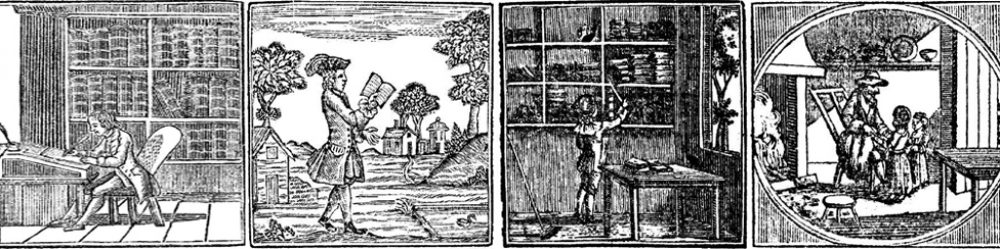

A Book for Jennifer, (Cotsen 7267)
With this newspaper advertisement the legendary publisher John Newbery launched five new books in 1764, available to only the good children who called at his shop in St. Paul’s Churchyard:
The Philosophers, Politicians, Necromancers, and the Learned in every Faculty are desired to observe, that on the First of January, being New Year’s Day (Oh that we may all lead new Lives!) Mr. Newbery intended to publish the following important Volumes, bound and gilt…
- The Renowned History of Giles Gingerbread, a little Boy who lived upon Learning
- The Easter Gift; or the Way to be very good
- The Whitsuntide Gift, or the Way to be very happy
- The Valentine’s Gift, or how to behave with Honour, Integrity, and Humanity; Very useful in a trading Nation
- The Fairing; or a Golden Toy for Children of all Sizes and Denominations.
These books would sell on their strength as interventions in a social crisis. Newbery declared in an essay to parents and governesses that “when all Complain of the  Depravity of Human Nature, and the Degeneracy of the Present Age, any Design, that is calculated to mend the Heart and inforce a Contrary Conduct, must surely claim the Attention and Encouragement of the Public.” The Valentine’s Gift, for example, encouraged that the celebration of the holiday be disassociated from the traditional gifting of ribbons, love knots, gloves, and stockings and restored to its original Christian purity. According to some authorities, St. Valentine urged his followers to choose their partners by lot and devote themselves the next year to advising, not romancing them (today’s specialists point out there is no proof of this practice associated with the saint).
 The author of The Valentine Gift laid out the new plan for honoring the day. On Valentine’s Day morning, partners would be chosen randomly: the first boy, girl, man, or woman a person saw would be the year’s companion for whom he or she would be responsible. The couple would keep their running moral accounts in order with copies of Newbery’s Important Pocket-book, which contained a ledge to track expenses and behavior. One of the stories in the volume, “A Remarkable Cure effected by the Valentine’s Ledger (i.e., the Pocket-book) showed how the inveterate liar Sally Brown, changed her ways after being turned out of her parents’ house, thanks to the gift of the book by the kind Mrs. Jewson. A more interesting one revolved around a princess who was not especially pleased with her lower-class valentine, the palace mason. When he uncovered a plot to assassinate her by wicked ministers, she discovered his true worth and that of having valentines for a year.
Of course, the book’s illustrations do not include any hearts or flowers. The Renowned History of Giles Gingerbread was by far more popular than The Valentine’s Day Gift and its companion volumes. It does have one claim to fame and that is the story of Old Zigzag,a predecessor of Dr. Dolittle. Mrs. Trimmer remembered Zigzag fondly as “the renowned translator of the language of Birds and Beasts, who in former days so successfully moved the hearts of Infancy for the distress of the animal world.” With the help of a magic horn, Zigzag interviewed birds, insects, and mammals about their treatment at the hands of men. So moved by what he heard, he may have destroyed the horn so that he would not have to listen to such terrible tales again. But he might have left it to Mr. Newbery so their stories could be transcribed for little readers.
Newbery’s book does not appear to have pushed back the romantic observance of Valentine’ Day, but it was an early attempt to monetize the holiday by selling products, albeit ones to improve rather than gratify.


