Say “paper dolls” and one of the countless cut-out paper figures created by Tom Tierney (1928-2014) for Dover Books may come to mind. His formula of highlighting a celebrity or historical period and providing a small closet’s worth of suitable garments, all with tabs on the shoulders which fold down and “dress” the doll, is credited with the revival of a nearly forgotten genre.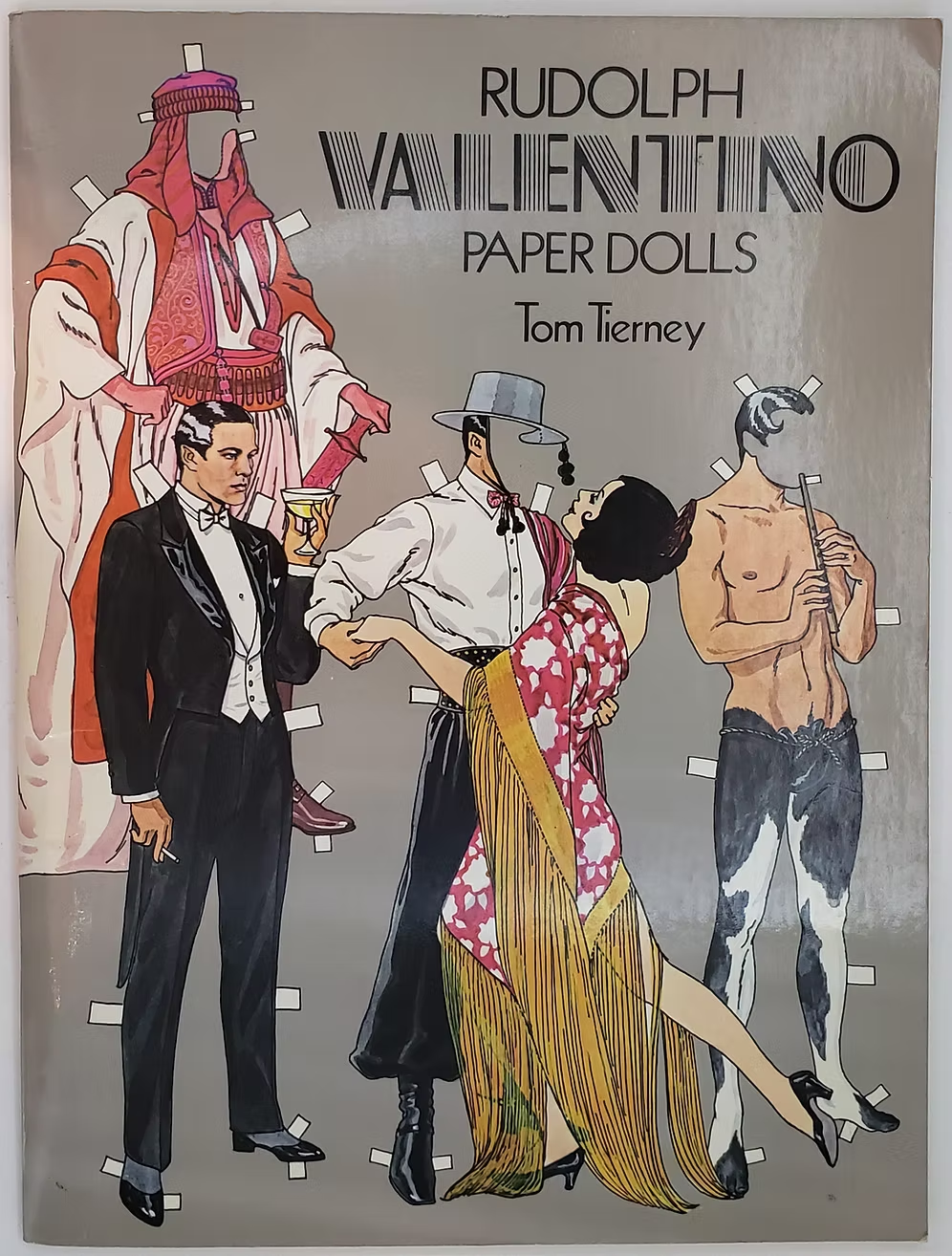 Actually paper dolls have taken several forms—and continue to do so–but that is beyond the scope of this post. Although considered ephemera, the production standards can be high, as reflected in the cost. The early nineteenth-century paper doll books are among the most desirable of all. (They are sometimes called toy books, a term which conflates them with mid-century illustrated pamphlets of Routledge and Warne.)
 Paper doll books were a specialty of Samuel and Joseph Fuller, retailers of art supplies, drawing books, prints, and fancy stationery at the Temple of Fancy in London 1809-. The Fullers brought out a series of them between 1809 and 1819, the most spectacular being Cinderella complete with coach, prince, and vicar shown above. Each title consisted of a pamphlet telling the story of the titular character, who is depicted in different poses and costumes in engraved illustrations. The pictures on stiff paper are cut out and laid into the pamphlet at the appropriate places in the story. Only one head on a long tab is provided. The reader is supposed to complete each picture by sliding it into the tab into a little sleeve on the back.
 In the early 1820s the French engraver and print entrepreneur Augustin Le Grand must have seen Fuller paper doll books and decided to write, illustrate, and publish his own for the more discerning Parisian market. Delphine and Emma are parallel tales of a bad and a good girl, reflecting the more conservative expectations for French young ladies.
The spoiled heiress Delphine, who disobeys her nurse, gives into her passions, and lives mostly on sweets until her health is compromised. Her anxious mother sends her to the country for an extended stay. She returned home with the roses were restored to her cheeks but her defective character unimproved. Gifts of fashionable clothing and jewelry are offered as an incentive to curb her sins of pride, sloth, anger, and ignorance, but on the promenade the bonnet is crushed, the umbrella broken, the spotless white Empire gown torn in two places, and a nest of baby birds thoughtlessly destroyed. Desperate to improve Delphine, her mother agrees to a ruse which required she be told that she was adopted, banished to the home of her real parents (a trusted family of servants), and sent into service. Even this humiliation is not enough to force a change in heart. Delphine dies aged sixteen. The story of her virtuous counterpart Emma offers a better example of how to succeed in life. She is the dutiful daughter cares for her beloved mama during her final illness. She is left an inconsolable orphan when her father follows her mother to the grave. Her aunt, having lost her only daughter, adopts Emma so that her education can be completed in time to improve her chances upon entering society. Everyone is charmed with her modesty, beauty, and elegance and she soon receives an advantageous offer from a wealthy admirer.
 Delphine and Emma were old-fashioned by English standards, authors having mostly moved past the old Hogarthian progress to more realistic and sympathetic treatments of children’s faults and mistakes. But Le Grand’s packaging was breathtaking. Delphine and Emma were issued in apple-green wrappers with shaped title labels printed in colored inks; the pair was inserted in a glazed pink paper slipcase (think Pantone Cherry Blossom) with a shaped, elegantly engraved title label in italic script surrounded by a delicate ornamental border. The Fuller paper doll books were bound in neat, serviceable printed wrappers on drab paper, which suffer in comparison to Le Grand’s.
 And here lies the paradox of the paper doll book: it underscores the importance of appearance to girls by clothing the character in fashionable clothes in the illustrations, while simultaneously trying to moderate the love of finery in the narrative. There is, of course, the delicious irony that Emma who values virtue more highly than dress makes a good marriage which ensures the necessity of dressing fashionably in society, while the passionate Delphine in her disgrace still cuts an adorable figure as a maid. Alas, their heads can register only one emotion throughout.
 The paper doll book survived beyond the 1820s, I was interested to discover. The Victoria and Albert has a charming example with story and figures made by a young woman in the 1830s. Hartford publishers E. B. and E. C. Kellog published a paper doll book version of Maria Susanna Cummins’ best-selling novel, The Lamplighter shortly after its publication in 1854. But the paper doll with the transferable head shorn of any improving narrative was the format for many, many sets of paper dolls by any number of publishers in America, England, and Europe from the 1850s on down to the present day.


