Disney released Snow White, the latest live-action remake of one of the studio’s classic animated films last weekend, with the controversy about the leading ladies’ political differences still simmering. (Rachel Zegler [Snow White] and Gal Gadot [Queen] appear in civilian clothes on the right.) The flurry of commentaries seemed more or less agreed that the House of Mouse was trying to force a poison apple down the public’s throat. The likelihood of successfully updating this particular fairy tale for the 21st century seemed doubtful because it has as many problems as Sleeping Beauty, with a passive princess awakened with a nonconsensual kiss after a century of slumber. The box office take last weekend dropped significantly.

Zegler as Snow White and the dwarves, who were not played by actors with the syndrome but created by through a combination of techniques including C. G. I.
For Disney, the top priority has to be sustaining the brand with periodical reinvention of its classics. Reviewers who are under the spell of Disney magic point out that the studio must create for a new generation the experience of seeing the original in new dress because of its investment in theme parks, merchandise, etc. The business logic is impeccable, but the strategy never would have been possible if Disney had not availed itself of stories in the public domain and then taken their commodification to new levels.
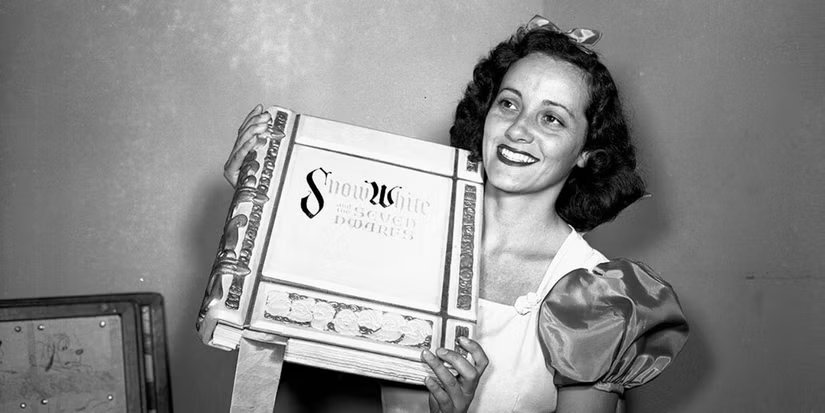
Adriana Caselotti, the voice of Snow White, posing with the book that figures in the opening sequence. She was not credited in the film.
Watch the 1937 original Snow White and it’s clear as the nose on a dwarf’s face that transforming a sparely worded 10-page story into an 84-minute film requires sacrificing good scenes,expanding the action and elaborating details out of whole cloth. Adding and subtracting has always central to the Disney approach to adaptation and sometimes it’s good, sometimes it’s mixed. Hard to argue with eliminating Grimm’s quiet opening of the queen embroidering during a snowfall and beginning with the brooding spirit in the magic mirror telling the stunning evil queen what she never expected to hear. A few details in Grimm allowed Disney to spin the vertiginous scene of Snow White running through the dark woods. Grimm briefly describes how the queen crossed the mountains to find her stepdaughter at the dwarves’ cottage, while in the film the crone punts down the misty river with the vultures watching overhead. Probably few people would object to the last change.
The ”liberties” the Disney team took in the famous scenes that frightened children work brilliantly because they are true to the story’s spirit and structure; the ones in the scenes with Snow White haven’t aged as well, because of the way the nonhuman is domesticated by sentimentality and physical humor. (That’s my take).
 The superfluity of birds and mammals Disney added have rounded, juvenile features that make their faces sweeter than they would be in nature. At Snow White’s bidding they wash the dishes and do the laundry and no one thinks of biting anyone else. Grimm’s “good little dwarves’” are transformed into a band of comically dim, bearded sidekicks in need of civilizing by the good little mother and housewife Snow White. These miners couldn’t hold their own in Middle Earth or Discworld because their dwarvishness has dwindled away to next to nothing.
 The collection has a nice selection of merchandise for the original animated film, marked in prominent places that it is authorized merchandise. All of them except one appeared in 1938 on the wake of the film’s release.
Whitman Publishing Company issued a 280-page retelling of the fairy tale by the “Staff of the Walt Disney Studios based on the Walt Disney Motion Picture” in the Big Little Book series (Cotsen 87872). Printed on acid paper that is brown and brittle, the illustrations were printed with such a coarse screen that the dots are quite visible. The quality of the cover art on the binding is much better, and the Queen is featured on the spine and the back board.

The Story of Walt Disney’s Snow White and the Seven Dwarfs. Racine, Wis.: Whitman Pub. Co., c1938. (Cotsen 87872)

(Cotsen 87872)
The dwarves were featured on a get-well-soon card published by White and Wycoff. Cotsen’s copy is annotated by “B. W.” (presumably the giver) and Snow White has been identified over her head as “Teacher” (Cotsen 37944). On the inside, Snow White is sitting in bed underneath a patchwork quilt with the dwarves lined up at the foot of the bed. Could the art have been adapted from the scene where the dwarves build her a bed that was cut in the final version?

[Snow White Get Well Card]. Walt Disney Enterprises, 1938. (Cotsen 37944)

Biancaneve ei Setti Nani. [Milan]: Carroccio, [ca 1938]. (Cotsen 40143)

Armour’s Present Snow White and the Seven Dwarfs Recipe Book. [England?: Armour?, not before 1937]. (Cotsen 15526)

(Cotsen 15526)
Disney could not resist promoting the art of the film in the Sketch Book published by Collins dedicated to the “eternal spirit of childhood in all of us” (Cotsen 4999). For each character, the color plate tipped onto thick brown paper is followed by three to four pages of reproductions of original sketches, with brief descriptions of the leading characteristics.

“Sketch Book“. London: Collins, 1938. (Cotsen 4999)
One of the surprises in the stacks was a set of Snow White cards published in China (Cotsen 94564). The illustrations are redrawn from the studio renderings and must be an unauthorized use. Sometimes the mighty Disney lawyers are caught napping.

[Gong he xin xi. China, not after 1950?]. (Cotsen 94564)


