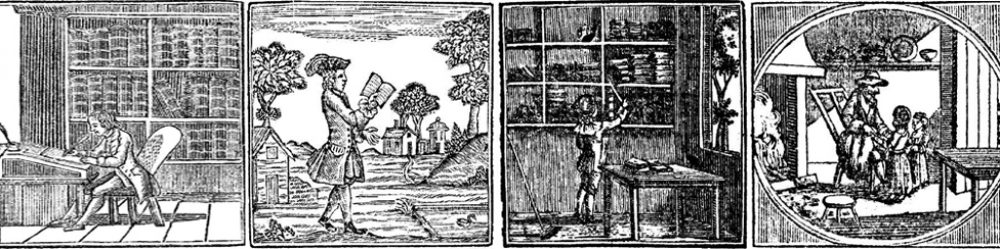
An Enslaved Woman Learns to Read in Eliza Fenwick’s A Visit to the Juvenile Library (1805)

Frontispiece to Eliza Fenwick’s Visits to the Juvenile Library. London: Printed by Barnard and Sultzer for Tabart and Co, 1805. (Cotsen 14522)

Visits to the Juvenile Library; or, Knowledge Proved to be the Source of Happiness (1805) is a scarce, desirable book by a stylish and important publisher of the Napoleonic era.  Benjamin Tabart was a rival of John Harris, who enjoyed the advantage of being successor to the great Newbery firm. While Tabart had the backing of the unscrupulous Sir Richard Phillips, he still had an uphill battle establishing his bookstore as a destination for families.

Visits  was less a novel than an extended exercise in product placement for his new business on New Bond Street.  It was written by Eliza Fenwick (1766-1840), the friend who nursed radical feminist Mary Wollstonecraft (1759-1797) when she lay dying.  An on-again-off-again marriage to a charming deadbeat with a bottle problem, had forced Fenwick to put on hold her ambitions as a novelist, being obliged to take what paid work the book trade there might be to support her little family.  During 1804 and 1805, she produced Visits and several other children’s books which cross-promoted Tabart’s backlist and premises.  The street-level view of the shop in the frontispiece  advertises that  he stocked books for lessons and leisure reading in English and French appropriately priced for private individuals or wholesalers.  As an additional inducement to stop by, a little boy is shown dragging his mother by the hand towards Tabart’s door, while a somewhat older boy peers in the window crowded with books. Wiling away part of the day in Mr.Tabart’s comfortably furnished shop, filled with books arranged by subject, looks like a pleasant expedition.  Through the double door, a cheery blaze in the fireplace in the back room can be seen.  There is a little animal lying underneath the chair on the left, but it is hard to tell if it is the shop cat or the customers’ dog.  Fenwick presents this shop as a temple of learning which will become the site of several conversions to literacy.

The five orphaned Mortimer children are sent away from their home in the West Indies after their parents’ death to live with the kind, intelligent guardian, Mrs. Clifford.  These circumstances  in children’s novels of this period always initiate a narrative arc of personal improvement. Child characters like Thomas Day’s Tommy Merton, who spent any amount of time on Caribbean plantations, are presumed to have received little or no education and can be expected to act out, as they have never had to control themselves.   The Mortimers are no exception.  Idle and quarrelsome among themselves, the children are sullen, haughty, or rude to Mrs. Clifford, who is concerned by their listlessness and lack of curiosity.

Of course the Mortimers have no idea of how to pass their time beyond  tracing the roses in the drawing room carpet.  “I always grow low spirited when I am obliged to read,” declares Richard.  Says the youngest ,Caroline, “I had rather have another wax doll, for I am quite tired of mine already.”  Louisa asks, “Now, Mrs. Clifford, are you going to be cross Mrs. Clifford?  Nora said you would make us read, and write, and work until we should all be quite wretched.”

Nora is the woman of color who has been the Mortimers’ slave.  She has come with them to England with some trepidation.  Her affection for the children is genuine, but  she has encouraged them to believe that “there was no occasion for rich people to be learned.”   Being illiterate herself, she supposes that “Reading and writing were only to be acquired by excessive suffering.”   During the sea voyage, she kept repeating to the children that England would be a “dull disagreeable” place to live, where there will be no slaves to wait upon them,” only tutors to flog them.  Nora’s worst fears are confirmed when she goes into the library by mistake and sees Mrs. Clifford seated at a table covered with books, writing a letter.

Thanks to Mr. Tabart, Mrs. Clifford is not obliged to remove the Mortimers from Nora’s influence and send them away to school.  Her friend Mr. Benson tells the children all about the Juvenile Library and suggests that some of the many books there might interest them.  While  too proud to admit to the adults  that they would like to go to New Bond Street, some of the children the Mortimers meet convince them that it could be quite pleasant to stick their noses in books  full of interesting stories and pictures. Their new acquaintances Edward Soames and Frank Howard describe their favorite Tabart titles and are even generous enough to loan them out.  The  Mortimers  spend the first evening of their lives busy and happy.  Nora notices the change in her charges and wonders if her dislike of Mrs. Clifford is misplaced.

It is not until chapter five that the children finally go to Tabart’s.  Once inside the shop,  they can hardly decide what to chose–books, jigsaw puzzles, prints, or globes   Mrs. Clifford expertly helps each Mortimer to  select a small group of titles that will hold his or her attention and lay the foundation for further study.  They take home works of natural history, biography, French grammars, spellers, easy readers,and poetry anthologies.  Mr. Tabart himself waits on the party until  called away on other business. Soon after this expedition, Arthur happily describes how he has changed since discovering  the pleasures of reading: “I find myself quite a different boy to what I was when I used to life half the day upon the sopha, or was always quarreling with my brothers and sisters, for want of something better to do.”  This change is not  lost upon Nora.One evening Arthur and his brother Henry go up to their room and surprise Nora sounding out words in William Mavor’s English Spelling Book.  Obviously embarrassed, Nora explains that “Well me tell all–you, Massa Henry, was cross boy, sometimes cruel boy to poor Nora–you, Massa Arthur, use to call Nora here, send Nora there; never satisfied if Nora sat down a moment, and you sit still and scold all day.  Since you come to England, you get books, you read books, you talk together, play together, read again, play again, be happy, be merry, fetch your own play-things, put the away no call poor old Nora down stairs, up stairs, now pick up a ball, now to tie your shoes, no scold and quarrel with Nora when you go to bed; all kind and good to Nora now.  Nora think you have learn it all out of books, so Nora learn books too.”  Her outburst shames the boys into apologizing for having been “sad tyrants” to her.  Not only do they promise to continue to give her “any such cause to complain of them,” but Henry volunteers to teach her to read and Arthur to write, so that she can write letters to her sister in the West Indies.

What are we in the twenty-first century to make of this early nineteenth-century story about how the West Indian-born Mortimers and their slave Nora embrace education as the high road to happiness? The use of dialect is cringe-worthy.  Lissa Paul, author of a new biography about its author Eliza Fenwick, observes how  how unusual it was for an enslaved person to be presented in such a positive light in children’s stories then.  And Nora is represented in the plate as an attractively dressed woman–indeed her pose while seated at the table is perhaps inappropriately sexualized  Nor is Nora’s conversion is  unambiguously positive, if scrutinized a little more carefully.

She seems not to have accompanied the children to Tabart’s, which probably would have been the case, given her low rank within the hierarchy of servants as the nursery maid.  Certainly Nora displayed the curiosity, initiative, and determination to go through all the books from Tabart’s lying around the children’s rooms in order to find the one she needed to teach herself to read.  But she hasn’t gotten any farther than sounding out words of one syllable when the boys interrupt her.  And her “simplicity” is what is emphasized.  Does “simplicity” in this context refer to her direct manner of speaking, or to her intelligence (think of Edgeworth’s “Simple Susan”)?  Does it imply that Nora would not have been able to make much progress towards full literacy if Henry and Arthur hadn’t offered to be her tutors?  Surely it would have been quite difficult for her to have learned how to write without a teacher.  Nora decided to improve herself because of the improvement she noticed in her charges, but readers don’t get the chance to see how far she progressed.  Fenwick moves on to the education of the two Mortimer girls and readers hear nothing more about Nora.  It would have been a triumph if she had been shown giving Mrs. Clifford a letter to her sister to be franked, but that is probably an unrealistic expectation on our part…


Ride an Elephant and a Happy Lunar New Year

This Saturday, January 25, is Chinese New Year. Happy Year of the Rat!  To celebrate this holiday, we invite you to read a post by Minjie Chen from 2013 explaining all the auspicious symbols in a Chinese New Year print in the collection.

The Cotsen Library is home to an international poster collection that depicts children and reflects childhood from diverse historical periods, geographical areas, and cultural backgrounds. Through a pilot project in 2012, the Cotsen Library enhanced catalog records of a small set from its Chinese-language poster collection to allow researchers to search for posters by title, creator, or publisher information in both Chinese characters and pinyin phonetics. Subject headings were standardized to bring consistency to terms that describe the posters. A brief summary of the visual content is also provided.

The small set of about 50 posters dates from the early twentieth century through the mid-1980s. They cover a delightful variety of subject matter, including nianhua (年画, New Year prints) that decorated people’s homes, instructional wall charts for classroom use, and Communist propaganda posters that sent political messages to children and adults alike.

An untitled and undated New Year print gives us a glimpse of multiple facets of Chinese art, culture, history, and political dynamics. The only text in the picture is a red stamp of “Tianjin Yangliuqing Painting Shop” (天津楊柳青畫店), a press based in one of the most famous production centers of Chinese New Year prints. Traditional Yangliuqing art was known for the so-called “half printed, half painted” woodblock New Year prints: combining mass production and original folk art, pictures were first printed in monochrome outline, and each piece was then hand-colored by artisans. The Costen’s copy was printed and painted on a sheet of xuanzhi (宣纸, Chinese rice paper), measuring 30 x 20 inches.

Catalogers occasionally find themselves facing the little-envied job of coming up with titles for library materials that carry no such information. This New Year print posed such a task. How would you name an image portraying three children on the back of an elephant? The old catalog record suggested a title about celebrating the harvest. In order to justify that theme, one might have expected to see depictions of abundant grain overflowing from containers. However, could the basket of fruit in the young Chinese girl’s hand be an Eastern equivalent of cornucopia?

New Year print: [Ji xiang ru yi] (吉祥如意, An auspicious and wish-fulfilling year). Tianjin, China: Tianjin Yangliuqing Painting Shop, circa 1958-1980. Cotsen Children's Library, call number 64129

New Year print:
[Ji xiang ru yi] (吉祥如意, An auspicious and wish-fulfilling year).
Tianjin, China: Tianjin Yangliuqing Painting Shop, circa 1958-1980.
Cotsen Children’s Library, call number 64129

Boy on the back of an elephant. A common pattern for traditional Chinese folk art. (Image source)

Boy on the back of an elephant. A common pattern for traditional Chinese folk art. (Image source)

It is unclear whether this New Year print was made around 1958-1959, when the Yangliuqing Painting Shop was established but not yet merged into the Tianjin People’s Fine Arts Publishing House, or around 1974-1980, when the shop name was restored.1 The picture is a fascinating manifestation of how tradition underwent adaptive transformations and survived a new political environment under the Chinese Communist regime.

Traditional Symbols and Communist Twists

Chinese New Year prints traditionally employ visual symbols and homophonic riddles to convey good wishes for the coming new year. Young children are among the favorite subject. Often portrayed with pink cheeks and chubby torsos, healthy-looking youth symbolize the success of family reproduction and a hopeful future. It is important to point out that images of children in Chinese New Year prints did not denote a child audience, but were intended for all viewers, particularly adults who wished to accomplish the foremost Confucian virtue and goal of raising a large family with sons and grandsons. Children were nonetheless an important part of the viewing experience. Superstitiously believing that children’s naïve voice carried some realizing power, an adult would engage a child in observing and talking about the pictures on the morning of the New Year’s Day, hoping that those lucky words from a child’s mouth would make happy things happen.

This New Year print from Cotsen is both a continuation of that “baby-loving” tradition and a departure from certain age-old characteristics. In a society that favored sons over daughters, boy figures dominated the subject of traditional New Year pictures. The presence of two young girls in this post-1949 picture, however, reflects an adherence to the idea of gender equality promoted by the Chinese Communist Party. All three children wear red scarves, indicating their membership in the Young Pioneers, which is a school children’s organization that answers to the Chinese Communist Party. (Former Chinese president Hu Jintao was the national leader of the organization in 1983-1984.)

Giant-sized peaches, shown in the basket on the right, are a traditional symbol of longevity in Chinese culture. The golden pineapple on the left also conveys wishes for good things, because the name of that fruit and the word for “prosperity” are homophones in southern Fujian dialect. Another homophone is played on the elephant. In the Chinese language, qixiang (骑象, riding an elephant) and jixiang (吉祥, auspicious) sound similar. The visual motif of elephant riding can actually be traced to the popular depiction of Samantabhadra, a bodhisattva often seen perched on an elephant in Chinese art and sculptures.

A final point of interest is the blossoming branch held high in the girl’s hand on the left. Traditionally, a more common object held by the elephant rider would have been an expensive-looking ruyi (如意). The term literally means “wish fulfillment,” and, according to popular belief, it has originated from the use of the handheld object as a self-sufficient backscratcher. Ruyi made from precious metals and stones used to be royal possessions. In Communist China, it would likely be a distasteful object associated with wealth, power, and privilege, and thus wisely avoided by the anonymous folk artist of this picture. The position of the girl’s arms, and the way she tilts her head closely resemble what we see in a ruyi-holding boy in traditional depictions. Is the pink flower branch an earthly substitute for rich men’s ruyi for political safety?

A ruyi decorated with pearls, made during the Qing dynasty (1644-1911). Collection of the National Palace Museum in Taiwan. (Image source)

A ruyi decorated with pearls, made during the Qing dynasty (1644-1911). Collection of the National Palace Museum in Taiwan. (Image source)

An auspicious and wish-fulfilling year

You may find this picture in our library catalog by its new title: “Ji Xiang Ru Yi” (吉祥如意, An auspicious and wish-fulfilling year). Attesting to the flexibility and resilience of a folk art tradition, “Ji Xiang Ru Yi” has merged old and new, catered to both popular and political tastes, and wished for another new year of good luck to come.

(The author thanks Mr. Don Cohn for offering insightful cultural information about Samantabhadra.)

Note:

1. Tianjin Yangliuqing hua she. (n.d.). Retrieved May 23, 2012, from http://www.tjwh