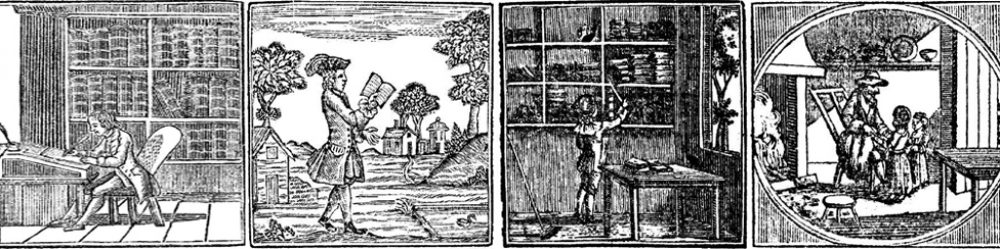
 Benjamin Franklin (1706-1790) began his career as a printer with ink on his hands and ended it as a diplomat in a coonskin cap. He was America’s Enlightenment polymath, an author with a down to earth wit and approachable style whether he was writing moral essays, composing promotional pamphlets for his inventions, or his autobiography. His reputation as a scientist and statesmen extended far beyond the borders of America.
James Daugherty, author/illustrator. Poor Richard. New York: Viking Press, 1941. Author/illustrator’s copy. Gift of the Friends of James Daugherty Foundation.
 At twelve, Franklin was bound apprentice to his brother James the printer. He saved James money by asking for half the amount spent on his board and making alternative arrangements. By going without meat, Ben squirreled away half that sum for purchasing books and gained time to study them during meals. In spite of this mutually advantageous arrangement, the brothers heartily disliked each other. Franklin did learn the business during the five years he served before running away to Philadelphia.
Ingri and Edgar Parin D’Aulaire. Benjamin Franklin. Garden City, New York: Doubleday & Company, 1951. Stated first edition. Cotsen 15209.
 The 17-year-old runaway apprentice arrived in his adopted city of Philadelphia with extra clothes, a little money, and no friends. Accustomed to living on bread with no butter, he bought three large puffy rolls to keep him going. Watching the dusty lad walk and eat down Market Street, his future wife Deborah could not help laughing at him. In the Autobiography, Franklin called it an unlikely beginning for the founder of Philadelphia’s first circulating library, volunteer fire department, hospital, and the American Philosophical Society.
Margaret Cousins. Ben Franklin of Old Philadelphia. Illustrated by Fritz Eichenberg. (Landmark Books, 28). Stated 2nd printing. New York: Random House, 1952.
Franklin was not shy about offering his boyhood as a model for others in the Autobiography (1790). Sarah Candler retold those anecdotes to her young readers in Buds of Genius; or Some Account of the Early Lives of Celebrated Characters who were Remarkable in their Childhood (1818). She encouraged them to dip into it for themselves: “He has written his own life in a very easy style, I think you are, even now capable of understanding the greatest part of it.” The table of contents reveals that Franklin was in the exalted company of scientist Sir Isaac Newton, poet Alexander Pope, and historian Edward Gibbon.
 One of Franklin’s early successes as a writer was editing the long-running Poor Richard’s Almanac, famous for the selection of snappy unillustrated proverbs. They were revived for 20th century children in this picture book brought to life by illustrators Maud and Miska Petersham with their good-natured humor. The one about the wax head comes from 1749 issue, the one about the king 1759 (Franklin may have borrowed it from poet George Herbert). Care prevents the monarch from getting out of his head, while the doll loses hers through carelessness.
 A Bird in the Hand: Sayings from Poor Richard’s Almanack. Illustrated by Maud and Miska Petersham. (This Is America, 4). New York: Macmillan, 1951. 1st printing signed by the artists.
 A 1960s Superboy comic book featured Franklin as the canny publisher of the Pennsylvania Gazette who spots talent in the young Clark Kent in pigtail and tricorne. His cub reporter keeps American history on track by using his heat vision to relight a lamp in the Old North Church so Paul Revere will receive the correct signal. When Franklin reads his write-up of Revere’s ride, he exclaims, “Egad! How you got this news I do not know. But I do know my paper will be the first with it!”
Bill Finger. “Benjamin Franklin’s Super-Reporter.” Artwork by Al Plastino. Adventures Comics, no. 296, May 1962, Mort Weisinger ed. Sparta, ILL.: National Periodical Publications, Inc., 1962.
As the editor of an anthology for young people, Franklin undoubtedly would have been tickled to see “The Whistle,” one of his best humorous essays based on a true story, anthologized for the same audience in The Young Gentleman and Lady’s Instructor; or New Reader and Speaker: Being a Choice Collection of Pieces in Poetry and Prose, (Lewes: Sussex Press, printed and published by J Baxter, 1808). The narrator remembers losing all pleasure in a whistle when his siblings tease him for having paid too much for the trifle. He then reflects on the consequences of valuing the wrong things too highly. The slyest example is the pretty girl who marries a handsome brute and learns the hard way that she paid too much for her whistle.
 Franklin appears most often in children’s books flying the kite in a storm to prove that lightning is electricity. Accounts are not always correct, as in this one by Agnes Strickland, who got several important details wrong. The more durable silk, not paper, was stretched across the kite’s frame. The attached wire acted as a lightning rod and sent the current down the damp hemp line to the key near its end. A non-conducting silk ribbon was tied to the hemp to prevent the operator from being electrocuted. To keep the ribbon dry, Franklin watched from inside an open shed.
Agnes Strickland. The Moss-House: in Which Many of the Works of Nature are Rendered a Source of Amusement to Children. London: William Darton, 1822. From the collection of Marjorie Moon
Franklin figured prominently in the two chapters on electricity in Harry and Lucy Concluded (1837), Maria Edgeworth’s remarkably engaging introduction to Enlightenment-era science for children. Harry and his sister Lucy learn all about the famous experiment during a thunder storm but also the Philadelphia sage’s turn for mixing nonsense and science. Lucy takes great pleasure in reading his 1745 letter about an imaginary “electrical party of pleasure” on the banks of the Schuylkill river where guests enjoyed turkey roasted by electricity. As the envoy to the court of France 1776-1785, 70-year-old Dr. Franklin took Paris by storm. Daugherty draws a shrewd old man in bifocals and coonskin cap fascinating the ladies of Paris. His choice of scene is a little unusual in a biography intended for children, but it brings out the fact that the elderly Franklin knew how to use his considerable charm in the service of his country.
James Daugherty, author/illustrator. Poor Richard. New York: Viking Press, 1941. Author/illustrator’s copy. Gift of the Friends of James Daugherty Foundation.
 While in Paris, Franklin also served as the head of the royal commission to investigate Franz Mesmer’s controversial treatment of diseases by manipulating the body’s magnetic fluid with electromedical equipment (it’s on the title page)t. The commission’s experiment discredited Mesmer’s theory of animal magnetism in what was the first blind controlled trial in medical history. The report’s analysis of the placebo effect is still considered a model of clear reasoning from observed phenomena.
 Mara Rockliff. Mesmerized: Ben Franklin Solves a Mystery that Baffled France, illustrated by Iacopo Bruno. Somerville, MA: Candlewick Press, 2025.
 Upon Franklin’s return from France, the Second Continental Congress appointed him, John Adams, Thomas Jefferson, Robert Livingston, and Roger Sherman to the Committee of Five whose charge was drafting the Declaration of Independence. Here Franklin scrutinizes the manuscript before suggesting to Jefferson that “hold these truths to be self-evident” be substituted for “sacred and undeniable.” Cotsen’s set of Real People biographies for children 6 to 9 originally belonged to the Phillip School library in Green Valley.
Frances Fullerton Neilson and Winthrop Neilson. Benj. Franklin. Illustrated by Robert Lawson. (Real People). Evanston, ILL and White Plains, NY: Row, Peterson and Company, 1950. Last and certainly least is this “charming rhymed adventure” is supposed to lead “tiny tots” through “the wonders of history and imagination,” a prime example of AI slop masquerading as biography. A tell tale sign of AI-assisted creation is that Franklin’s wig changes in the uncredited illustrations, but not his facial expression. The illustrations are full of errors: here the bifocal glasses should be balanced on their inventor’s nose. The clutter on the table does not include other important inventions like the lightning rod and energy-conserving Franklin stove. Not recommended!
Nicholas Jacobson. From Kite to Light: A Benjamin Franklin Book for Kids. North Haven, CT: Curious Kids Books, April 21, 2026.
Let’s go out with Lawson’s interpretation of the same idea in his illustrations for the Real People series…
 This post was adapted from a small exhibition, which was to be installed as part of the Princeton University Library’s celebration of the 250th anniversary of the signing of the Declaration of Independence–which Franklin helped edit.