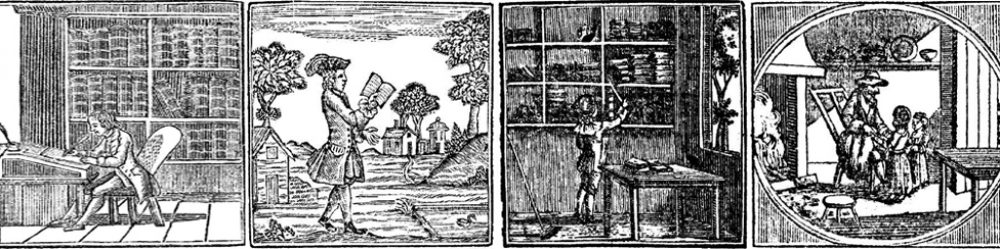
An engraver by trade, Richard Miller was also a publisher and the proprietor of a “juvenile library” (aka a children’s book store) at 24 Old Fish Street in early nineteenth century London.  His shop was quite close to the church of St. Mary Magdalen, shown in the engraving to the left, and south and east of Paul’s Church Yard, long a center of book trade activity. Miller was pretty small fry compared to John Harris, successor to the Newberys and a major publisher in his own right, or the Darton firm, with two bustling businesses at two locations in the city. By the 1820s, the children’s book market had grown so large that there was plenty of room for multiple shops catering to customers with different tastes and values.
Miller engraved attractive sets of illustrated cards that were sold for school and Sunday school rewards. The same sets of sheets were also sold bound as neat little volumes in marbled paper with colored roan spines. The bound volumes seem to have survived at a higher rate than the cards and certain titles still turn up fairly often on the antiquarian book market.
Cotsen has seven Miller publications and they were probably published in the 1820s (he did not date his title pages as a rule). There are four little books of engraved plates: The History of Birds, The History of Goody Two Shoes, Pastimes or Amusements for a Girl, and Twenty-Six Poetical Extracts. In the collection of educational cards there’s the Miller Pence Table in forty-eight hand-colored engraved illustrated cards. The 126-page The Panorama of the World, or An Enquiry into the Manners and Customs of the Principal Foreign Inhabitants of the Globe, illustrated with nine hand-colored engraved plates, is the only proper book in the group.
That leaves Military Heroes That Have Distinguished Themselves During the Late Wars (that is, the Napoleonic wars) I like it less for the fourteen hand-colored engraved equestrian portraits of great generals like Alexander the Great, Prince Blucher, and the Duke of Wellington, than for the twelve-page catalog of “Books and Fancy Articles” at the end. In the catalog this book listed under the title “Memoirs of Military Heroes.” With plain engravings, Military Heroes cost a shilling and with colored plates (which Cotsen’s copy has) two shillings. The portraits could also be purchased individually on superfine paper for two pence or as a set for two shillings. It was a fair price for such a things then, but not cheap.

Military Heroes That have Distinguished Themselves During the Late Wars. London: R. Miller, [not before 1815]. (Cotsen 35443)

(Cotsen 35443)
Overall there are plenty of indications in the catalog that Miller was more than a very clever packager of his own content. The opening below offers a delicious selection of novelty parlor games and educational flash cards. The packs of conversation cards include one called “Pop the Question,” which probably had nothing to do with the conclusion of a courtship. But maybe not, given the close proxmity to The Ladder of Matrimony and The Map of Matrimony. Obviously The Map represents an imaginary place, like the “country of sighs.” Still it was available as well as a jigsaw puzzle in a neat box as if it were something for teaching the geography of South America. Prints had been sold for centuries for sticking on walls as decorations and Miller obliged with the series “Cottage Ornaments” or hand-colored prints for two pence on such edifying subjects as the drunken man or the death of the Earl of Rochester. Certainly good enough for the parlour The best of the “Fancy Articles” Miller sold has to be the “Satin Medallion Pincushions” for a shilling that feature the portraits of the royal family and other famous people from Lord Nelson to worthy divines copied from the subjects on the preceding list of prints. Do any survive in textile collections? This double-page spread offers more evidence that Miller didn’t rely completely on his own wares to stock his shelves. He must have sold books by his competitors. W. F. Sullivan was a school master who wrote many early examples of what would now be considered young adult novels. He published with a variety of firms over the years, but none by Miller, as far as I can tell. The roster of eighteenth-century classics like Gay’s Fables and Chesterfield’s Advice to His Son were probably also not Miller publications. Tthe last title in that list is an edition of James Janeway’s Token for Children, one of the most famous and enduring of all seventeenth century juveniles. It is not out of place here, because there are quite a few religious titles sprinkled throughout the catalogue.
 The last page in the catalogue features lots of old favorites–II see two different editions of Dick Whittington and Blue Beard, based on the George Colman dramatic remake. What’s interesting even more interesting is the use of the term “picture book” to describe a work where the pictures dominate the words text. It seems that the term must have been in wider use earlier than the OED entry suggests (there is appearances of the term between 1699 and 1847).
 Nobody would claim that Richard Miller’s catalogue can compete with one from American Girl, Hearth Song, or any other modern company sells by mail or on the web. Even though he lacked the technical resources to illustrate every item in his stock with color pictures, he managed with just words to make his merchandise look enticing enough for the owner of Military Heroes to consider paying a call at the juvenile library on Old Fish Street.


