 In What The Presidents Read, Liz Goodenough and Marilyn Olson wondered:
A childhood book is much more than just a story—for presidents, it may represent a turn in the course of history. Did John F. Kennedy’s early love of Billy Whiskers, a goat who roved the United States bashing down doors and anyone in uniform, help pave his road to Camelot? The favorite readings of presidents can shape a generation, rising in stature like national legends or be completely forgotten.
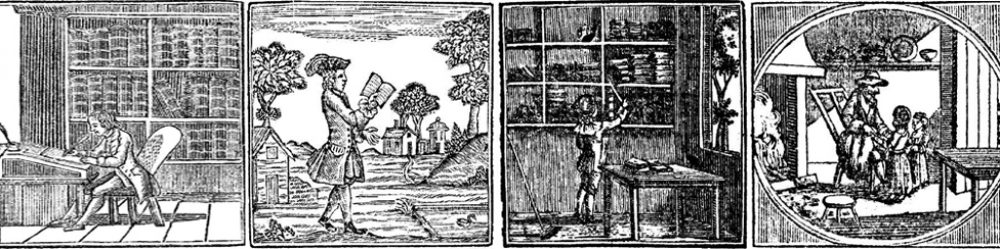
Almost completely forgotten is the penny pamphlet Renowned History of Giles Gingerbread, a little Boy Who Lived on Learning, a particular favorite of our fifth president, John Quincy Adams. It was first published in London by John Newbery in 1767. Perhaps five London editions issued between 1764 and 1782 exist; the survival rate is a little higher for reprints by provincial and American printers. The text was illustrated with sixteen wood cuts–one every other page, which was very generous for such a cheap pamphlet—and they illustrated specific passages in the text. The publisher’s binding would have been Dutch floral gilt wrappers. The pretty paper branded those books as appropriate for younger readers.

The Renowned History of Giles Gingerbread. London: Newbery, 1779. (Cotsen 153840)
Abigail Adams, the mother of the future sixth president, John Quincy Adams, said he could recite it from memory. We don’t know how old her boy was when he performed this feat because she mentioned it in a letter written when John was grown up. The anecdote is still solid gold because evidence about the reading of very young children is hard to come by, even in families in which the parents were highly involved in their children’s education. The Adamses thought a lot about their boys’ reading and Abigail sent amusing stories about their progress. John might write back with a message, like this one for John Quincy: “Tell him I am glad to hear he is so good a Boy as to read to his Mamma for her Entertainment and to keep himself out of the company of rude children.”
For an easy reader, The Renowned History of Giles Gingerbread was rather unusual and it seemed peculiarly suited to make an impression on John Quincy. Its contents were miscellaneous, but not divided up into sections of instruction and reading passages. In fact, it contained no direct instruction such as syllablaries. Could certain ideas in the bookseller’s preface caught Abigail’s eye?
The Reader perhaps may be so unreasonable as to expect an Account of the Birth, Parentage and country of our Hero. If he does, I can assure him he will be disappointed. There are circumstances which he has no Right to be informed of; for a good Man may be born any how; and anywhere; of any Parents, and in any Country…If a Man is a good Man and an honest Man, it is no Matter where he was born, and if those we have lately made such a Noise about Country and Party to Gaffer Gingerbread, he would have knocked their Heads together for being such boobies.

The Renowned History of Giles Gingerbread. London: Printed for T. Carnan, 1782. (Cotsen 6721)
The pamphlet’s heart is the exemplary story of Gaffer Gingerbread’s son Giles. When the little ragged boy jumps on the back of Sir Toby Thompson’s coach. his father calls him over, not because it was dangerous but because “You want to get up to the coach, but you are climbing at the wrong place, Giles; you should endeavor to get in at the door.” But poor folks can’t do that, protests Giles. Not true, says his father: “A poor man or a poor boy may get a coach, if he will endeavor to deserve it. Merit and Industry may intitle a Man to anything.

Giles Gingerbread. (Cotsen 6721)
He explains to tells Giles how little Toby rose above his station. through hard work, strict honesty, and attention to his master’s interests to become a wealthy man with a fine coach (this is an example of John Newbery’s “coach and six morality). When the merchant Mr. Goodwill saw how carefully Toby babysat his siblings, while his mother was off working, he sent him to school to learn to read and write, then brought him to London as a servant. Unfortunately, Mr. Goodwill paid more attention to race horses than his business and left himself open to fraud. After Giles discovered that a fellow servant had robbed their master, he informed Goodwill in an anonymous letter because it was his duty towards the man who had been a second father to him. When Giles revealed himself as the letter’s author, Goodwill was so grateful that Toby was made his business partner and heir to his fortune.

Giles Gingerbread. (Cotsen 6721)
With the story ringing in his ears, Giles begs his father to teach him to read so he too can become a great man. Being the son of a gingerbread baker who sold useful knowledge by the pound, he had easy access to the traditional educational aides of gingerbread alphabet letters and hornbooks mentioned in works by Matthew Prior, Thomas Tickell, and Tobias Smollett. Perching Giles on his lap, Gaffer Gingerbread took out of his pocket a gingerbread alphabet. To draw Giles into the task, his father exclaims that “all the Words in the World” can be made with these 24 letters. When Giles laughs in disbelief, his father demonstrates the truth of the proposition by spelling a short and a long word, then letting Giles try his hand. Giles gleefully runs through the letters in a little alliterative prose poem: “Mr. B, I should be a Blockhead if I did not know you—C, C, C, I shall know you Mr. C indeed, and so will every Boy that loves Custard—D, D, D, Drum and Dumpling will make me know you Mr. D.—E, E, E, Eggs and Eel Pye forever.” When Giles named the gingerbread letter, his father gave him permission to eat and that is how he “lived on learning.”

Giles Gingerbread. (Cotsen 6721)
Obedience, not rewards of food, was Giles’ true motivation to learn. His father’s wish was his command, whether it was putting the escaped pig back in the style or learning the lesson set for him. This, the narrator observes, was critical to his subsequent success. With his feet set on the right path by his gaffer, Giles soon attracts the attention of Sir Toby Thompson, who takes him to London in his coach. “We have heard nothing of him,” says the narrator, but his father declares that he is sure Giles will behave so well as to get Coach of his own.” Gaffer the small businessman understood as clearly as John Adams the value of education. The child who learned to read, acquired the habits of obedience, hard work, and scrupulous honesty would accumulate a degree of merit that would inspire confidence and trust in worthy people.
In spite of the disparity in social circumstances, littIe John Quincy may have identified more closely with Giles than Dick Whittington, thrice lord mayor of London. With no father to guide him, the orphan Dick, knew to obey his master and the cruel cook who ordered him perform the dirty work in the scullery. But luck was a more powerful factor in Dick’s rise than love of learning or hard work. He gives his only possession, the cat who has kept the vermin population down in his room, hoping to make a return on the investment when his master’s ship comes home. It was the steward’s bright idea to present Puss to the foreign king and queen to destroy all the vermin which overran their dinner every night, there being no mousers there. The royals pay the steward handsomely for the cat and he turns over the money to Dick. Would he have been more displeased than delighted by Perrault’s Master Cat, who pulls strings so that his penniless owner marries the king’s daughter without proving anything beyond he was very handsome.
At age ten, John Quincy gave his opinion of the picaresque novel Bamfylde Moore Carew to his father. The rogue Moore was a hero to many boys, but not John Quincy–what he liked best was the travel writing. He had internalized his father’s high-mindedness by scorning injustice, ingratitude, cowardice, and falsehood. John Quincy was a chip off the “old iceberg” and of old Gaffer Gingerbread.


