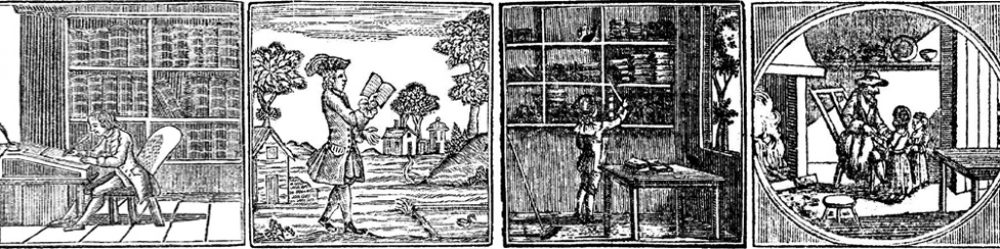
Nobody Is a Curious Chap

Not everyone knows that Nobody pops up in different guises in a surprising number of places.

One form he takes is similar to household sprites around the world like brownies, hobs, kobolds, tomtes, nisses, and elves, except that he only makes mischief instead of helping to keep the household running smoothly, only punishing the lazy.

He can live anywhere he pleases without being detected until he leaves behind a mess.  Barring and locking the doors and windows will not prevent him from entering and breaking glass, china, and pottery. If papers are found mixed up on the desk, books missing pages or nowhere to be found, he is the most likely culprit. The dog, cat, or parrot are sometimes blamed for these messes, but the real perpetrator  is Mr. Nobody. Reporting him to the police is pointless: while servants can confidently lay the misdemeanor to Mr. Nobody, not one of them will be able to give a description.

Complaints about him were lodged by disgruntled writers of occasional essays and letters to the editor in the late 1700s, if not earlier. In 1868 he popped up on the other side of the Atlantic in a poem Elizabeth Prentiss published in the Riverside Magazine 2.  On-line sites of children’s poetry sites give just the first of the four stanzas, which omit many more of the  minor crimes can be laid to his door, such as pulling buttons off shirts, putting damp wood on the fire, leaving fingerprints on doors, spilling ink or pins, tracking in mud from outdoors, throwing  dirty boots around the house.

I know a funny little man,
As quiet as a mouse,
Who does the mischief that is done
In everybody’s house!
There’s no one ever sees his face,
And yet we all agree
That every plate we break was cracked
By Mr. Nobody.

One of the oldest jokes in world literature hinges upon the word “Nobody.”  In Homer, Polyphemus, after enjoying the strong wine from the captive Odysseus, asks his name.  Odysseus replies, “Nobody,” to which the monster’s hilarious response is that “Nobody” will be the last eaten.  After blinding the drunken Cyclops, escaping the cave, and getting down to the ships,  the Greeks hear their host roar to his neighbors that he needs help because “Nobody has hurt him.” The exchanges depend upon whether “Nobody” is used as a pronoun standing in for “not anybody” or as a proper name.

When the future novelist Fanny Burney started keeping a diary age fifteen, the same gag was the opening’s centerpiece:

The only one I could wholly, totally confide in, lives in the same House with me, & not only never has, but never will, leave me one secret to tell her. To whom, then, must I dedicate my wonderful, surprising & interesting adventures? — to whom dare I reveal my private opinion of my nearest Relations? the secret thoughts of my dearest friends? my own hopes, fears, I reflections & dislikes? –Nobody!

To Nobody, then, will I write my Journal!

It would be quite reasonable to suppose that there aren’t any illustrations of a character who is invisible. But that would be wrong.  From the 1500s onward, the cousin, who spells his name “No-body” inspired artists and authors develop a robust iconography with a variety of backstories in prints, theater pieces, and satire (the fascinating transmission history is too complex to do justice here). The hyphen opened up comic possibilities the English language afforded: lacking a torso, long legs swathed in wide-legged breeches are attached to tiny shoulders with full-sized arms topped by a head.  Besides being the subject of woodcuts, he inspired a whole range of ceramic figures. Hogarth designed a tail piece featuring him.

He also made rare appearances in children’s books.  Here is the letter N, Sir Nobody, in a rhyming alphabet found in Mrs. Lovechild’s Golden Present, which was probably first published by Francis Newbery around 1770.  I haven’t found anything earlier.While looking for something else in a pamphlet box, I found an entire pamphlet devoted to him in Dean & Co.’s Uncle Buncle series: New Story about Master Nobody. Sometimes advertisements credit “Uncle Buncle” titles to a Robert Edgar, about whom little is known. Cover of Uncle Buncle's New Story about Master NobodyAlthough the character has been turned into a little boy wearing a skeleton suit, he conforms to the type with ridiculously long legs and arms unconnected to a torso.  And the humor is identical to Burney’s, playing off “Nobody” as a pronoun and as a proper name. 

Nobody needs a torso to ride a rocking horse into town.Master Nobody rides a rocking horse into townNobody has eyes so sharp he can look through a wall at little girls skipping rope on the other side.Master Nobody looks through a wallNobody nibbles the table cloth at dinner instead of tucking into roast beef and plum pudding.Master Nobody eats the table clothNobody takes a bow after folding himself into a quart bottle.Master Nobody's trick and bowAnd nobody is offended by his extended antics!


Little Thumb: Perrault’s Resourceful Abandoned Boy

The first illustration of the ogre and Little Thumb by Clouzier for the 1697 edition. The one is too big, the other too small…

No cousin to Tom Thumb, Perrault’s Little Thumb is the youngest son in a large, poverty-stricken family. His mother, who was “quick about her business and brought never less than two at a time,” had seven boys in three years (all quotes from the Robert Samber translation of 1729 reprinted in the Opies’ The Classic Fairy Tales). Small without much to say, the family thinks Little Thumb is slow. Everyone blames him for whatever goes wrong without suspecting that the seventh son has excellent survival instincts, quick wit, good luck, and a ruthless streak. Even if a fairy deigned to look in on a poor family, her assistance would be superfluous.

Gustav Dore’s illustration of Little Thumb eavesdropping under his mother’s stool.

A bad year comes and the parents cannot support the nine of them gathering faggots. Sharp-eared Thumb overhears his father and mother discussing whether it would be better to watch the boys starve to death or lose them the forest and let the wild beasts eat them. By dawn, he has figured out a plan to mark the family’s path into the woods with white stones, whose trail they can follow home. They receive a warm welcome and the remains of a good supper, a luxury afforded by a long overdue payment of ten crowns from the lord of the manor.

The parents’ desperation returns as soon as the money runs out. Little Thumb listens in on their talk of losing their children by leading them much deeper into the forest but is unconcerned with the plan in his pocket. But the door is locked and he cannot leave to gather pebbles early in the morning. He improvises and drops crumbs from his breakfast roll instead, but the birds eat them all.

With night falling, soaked to the skin from the driving rain, and hopelessly lost, Little Thumb persists and leads the band some distance to a house, where he asks the good wife, who opens the door, for shelter.  He persuades her that they would rather take their chances with her husband the ogre, who might spare them, than with the wolves outdoors, who won’t. The ogre, with his keen nose for fresh meat, discovers the boys’ hiding place under the bed, and prepares to butcher them to serve with anchovy and caper sauce to his three mates coming for lunch. His wife talks him out of it and he orders her to feed them and put to bed in the same room as their seven daughters, gray-eyed and hook-nosed  with “very long sharp teeth…not yet very wicked, but …they had already bitten several little children so they might suck their blood.”

Although the boys are in a separate bed, Little Thumb notices that the little ogresses are wearing golden crowns and quickly switches their nightcaps with the girls’ crowns, just in case the ogre thinks better of letting them live until morning. Sure enough, he comes in with the big knife, muttering about having had too much wine after dinner. To tell the boys from the girls, he needs to touch their heads. Feeling nightcaps, he cries, “Hah! my merry little lads, are you there,” cuts his daughters’ throats, and stumps back to bed. As soon as Little Thumb hears steady snoring, he gets his brothers dressed and out of the house.

George Cruikshank’s ogre is as skinny as Dore’s below is stout.

By dawn they have almost run the distance to their parents’ house, but the ogre in his magical seven league boots has nearly closed the gap between them. (Nothing is said about him being armed.)  Using the boots fatigues the wearer, so he settles down for a much-needed nap. Little Thumb orders his brothers to run home while he takes care of the ogre. Even if it had been possible to kill his enemy, it would not solve his family’s problems as nicely as stripping the monster of his most valuable possessions. Little Thumb steals the boots, which being fairy-made, magically shrink to fit him, and returns to the house to play a dirty trick on the wife, without any regard for the fact that she had tried to save the boys. Telling her that robbers are holding her husband for ransom, she hands over all his riches, and the boy returns home in triumph.  What’s more, he uses the magical boots to make money by carrying orders from the king to his generals or delivering love letters.

A rare illustration of the entrepreneur Little Thumb by Walter Crane. Hop o’ my Thumb. London: Routledge, Warne, & Routledge, [between 1860 and 1865]. (Cotsen 151850)

The moral of the story according to the worldly Perrault?  Something like when survival is at stake, the end justifies the means:

No longer are children said to be a hardship

If they possess great charm, good looks, and wit.

If one is weak, however, and knows not what to say,

Mocked he’ll be and chased until he runs away.

Yet sometimes it’s this child, very least expected,

Who makes his fortune and has his honor resurrected.

His parents seem to have been absolved of child abandonment because they were in extenuating circumstances. After all, blood is thicker than water, and Little Thumb preserves patriarchy by making enough money to make the family financially secure and elevating his father and brothers at court. And so Little Thumb escapes reproof for playing the spy, accessory to murder, thieft, and liar.  The ogre was no Christian anyway.

It’s amusing to see how many illustrators ignore the passage about the boots shrinking to fit the wearer…