
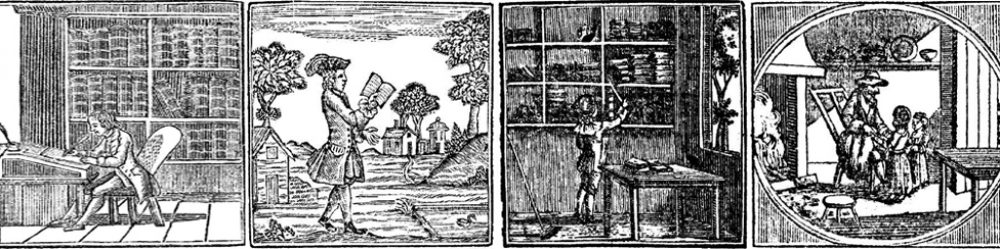
Front wrapper with an engraving illustrating a fable. Golden Precepts. Hartford, 1776. (Cotsen 34370)
Over the long holiday weekend, let’s take a second look at the post Ian Dooley, the curatorial assistant, wrote some years ago about a manuscript made by a child that is contemporaneous to the Declaration of Independence, with some additional comments by me.
The above image is the front wrapper of Samuel Holbrook’s copy book. Composed between June and September 1776 in Hartford, Connecticut and Boston, Massachusetts, this copy book is a rare artifact that has survived from the time of the founding of this country. Back when students learned to write using quill pens and ink, they practiced penmanship exercises of different kinds in blank copy books. They wrote out alphabets of Roman and italic letters in the upper and lower cases, proverbs alphabetically organized, passages from literature or arithmetic problems from an engraved instruction manual.
![page [8]](https://i0.wp.com/blogs.princeton.edu/cotsen/wp-content/uploads/sites/88/2016/07/34370page8.jpg?resize=584%2C745&ssl=1)
page [8]
Sam Holbrook’s copy book happens to have an entry that is a day earlier than a very auspicious date for this country. The maxims he copied out that day may not speak to the pursuit of Life, Liberty, and the Pursuit of Happiness, but they offer general guidelines for behavior appropriate for any good and upright citizen:
![34370page[1]](https://i0.wp.com/blogs.princeton.edu/cotsen/wp-content/uploads/sites/88/2016/07/34370page1.jpg?resize=584%2C719&ssl=1)
page [1]. Notice that Sam is using red ink for the headings and black for the precepts.
As you might have guessed, helping students store up ideas and thoughts that would be useful to them throughout their lives was as important as practicing penmanship. These kinds of proverbs in couplets and other aphorisms fill a significant number of pages in copy books (think of the sayings from Benjamin Franklin’s wildly popular
Poor Richard’s Almanac). Frequent topics are the cultivation of traits that smooth the way to wealth:
![page [11]](https://i0.wp.com/blogs.princeton.edu/cotsen/wp-content/uploads/sites/88/2016/07/34370page11.jpg?resize=568%2C694&ssl=1)
page [11]. Notice that Sam used red, blue, and black ink on this page.
Either Samuel Holbrook hadn’t heard the recent news about independence or had belonged to a Loyalist family. In the image below, Sam has copied out an extensive praise of British merchants and the far-reaching benefits of commercial activity across the country and around the globe–ideas now under question:
![page [13]](https://i0.wp.com/blogs.princeton.edu/cotsen/wp-content/uploads/sites/88/2016/07/34370page13.jpg?resize=584%2C488&ssl=1)
page [13]. Sam was probably using a British copy book, which might also explain all the pro-English sentiments.
He also copied out excerpts from poems about the death of a child, the death of a friend, a great storm at sea from Virgil, and a warning to girls about using makeup. If you want to get a more detailed idea of all the things children were supposed to learn by copying out texts, including page layouts, Samuel’s
copybook has been digitized. If you want to see how this copy book has been featured in our public programs, check out
this blog post by Dana Sheridan on the Cotsen Outreach blog Pop Goes the Page.
Happy 250th, everyone from sea to shining sea…

![page [8]](https://i0.wp.com/blogs.princeton.edu/cotsen/wp-content/uploads/sites/88/2016/07/34370page8.jpg?ssl=1)
![34370page[1]](https://i0.wp.com/blogs.princeton.edu/cotsen/wp-content/uploads/sites/88/2016/07/34370page1.jpg?ssl=1)
![page [11]](https://i0.wp.com/blogs.princeton.edu/cotsen/wp-content/uploads/sites/88/2016/07/34370page11.jpg?ssl=1)
![page [13]](https://i0.wp.com/blogs.princeton.edu/cotsen/wp-content/uploads/sites/88/2016/07/34370page13.jpg?ssl=1)


