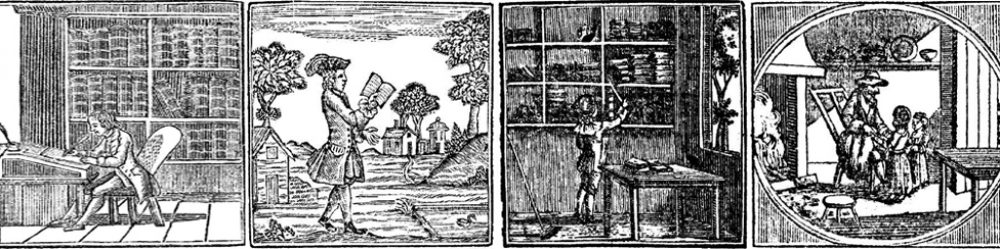
When people ask me to name my favorite book in the collection, there’s never have a good answer on the tip of the tongue. But If a heartless desperado were holding my cat for ransom and the conditions for her release were to name to a favorite book, I might be able to do it as long as I stuck to alphabet books.
One of my favorite alphabets is L’alphabet personnife ou Les lettres rendues sensibles par les figures de 25 enfants in action et portant le nom des 25 lettres elles-memes [The Personified Alphabet or the Letters Animated by the Figures of 25 Children in Action Bearing the Names of the Letters]. Cotsen just purchased the first edition of 1801, where it joins a copy of the 1809 third edition.
 Its author, the teacher Anne-Francois-Joachim de Freville, is a rather interesting person, even if he is not an immortal of French children’s literature. Freville’s most famous works were two collections of anecdotes about extraordinary real children. Vies des enfans celebres (1798) included the story of Irish youngster Volney Becker, who saved his father from a shark and was bitten in half while being lifted to safety on a boat. Vies circulated in English translation under the title The Juvenile Plutarch between 1801 and 1820. The second collection, Beaux traits du jeune age (1813), closes with an ambitious proposal for a pantheon to be built to honor the memory of notable children. He was arrested for Jacobin sympathies during the French Revolution but acquitted by the tribunal and kept his head. During the Directory, he continued to produce books that incorporated a range of educational games like the one below designed to turn children into active participants in their education.

A.-F.-J. Freville, Jeu d’alphabet, chiffres, et symbols.
L’Alphabet personnifie is perhaps the most ingenious and charming of them all and its design suggests that Freville was no ordinary teacher. Like many enlightened educators who came after John Locke, Freville tried to invent ways to reduce the drudgery associated with learning to read. Of course, he recommended using illustrated texts for that purpose, but on a different and more ambitious plan. While it was true that children enjoyed illustrated alphabets of animals in their primers, he observed, they usually retained more information about the animals’ appearance and characteristics than they did of the letters of the alphabet, the real object of the exercise.
A better approach, Freville argued, was to anthropomorphize the letters, because children would take greater interest in the symbols if they resembled children the same age as themselves engaged in enjoyable activities (the different costumes and hats were also supposed to be a source of amusement). The skillful use of alliteration increased the fun of learning, as well as an way of organizing the visual material so that it was more likely to impress associations on children’s minds. Verbs are the heart of Freville’s method, which is somewhat unusual, as alphabets are more likely to focus on substantives or nouns rather than actions.
Here is the letter “A,” impersonated by a boy watering [arrose]. When the children turn to the description of the plate, they will discover that it contains other objects beginning with the letter A: “Le petit Arlequin, arrose un Artichaut, fleuri dans son jardin” [Little Harlequin waters an artichoke blooming in his garden]. But if they look at the picture again, they will find even more objects whose names begin with “A” the description omits–“abeille” [bee] and “arraignee” [spider] to mention just two. The engraver signed his name below the greenery in the lower right and I think it says “J. Le Roy.”
 This being a French alphabet, the pleasures of the table must be shown. Here is “B” for “boit” [drink] and “M” for “mange” [eat].
 And the noblest of the fruits also makes an appearance in “V” for “vendange” [grape harvest]. More French fruits can be seen in a previous post on a new acquisition.
 Plenty of ways to work off the food and drink are also illustrated, such as “H” for “hache” [chop] and “N” for “nage” [swim].
 The boy is also shown practicing his handwriting in “E” for “ecrit” and playing in “J” for “joue.”
 The two editions are not identical. A careful comparison established that the reading exercises had been revised, but the differences are to complicated to describe here. A more amusing change was made to the plate for the letter Z. In the 1801 edition, “Z” pursued the zebra through the woods completely naked, whereas in the 3rd edition, he is draped in a diaphanous robe for the hunt, still with no shoes.


Perhaps the revised plate is having a little fun at the expense of the merveilleuses, the fashion victims of their times, who fancied dresses so sheer that they left very little to the imagination….

An English satirist like Isaac Cruikshank was probably not the most objective observer of French fashion…


![Bottom of leaf [3]](https://i0.wp.com/blogs.princeton.edu/cotsen/wp-content/uploads/sites/88/2016/02/leaf3bottom.jpg?ssl=1)
![Leaf [4], "Grandmama Leech 1872", perhaps the biggest fan of paper lace.](https://i0.wp.com/blogs.princeton.edu/cotsen/wp-content/uploads/sites/88/2016/02/leaf4.jpg?ssl=1)
![Inside of the card on leaf [4], perhaps a later original drawing by Beatrix Potter?](https://i0.wp.com/blogs.princeton.edu/cotsen/wp-content/uploads/sites/88/2016/02/leaf4inside.jpg?ssl=1)
![Leaf [6]. This leaf is one of many with sections or cards cut away, perhaps by Beatrix for a later project.](https://i0.wp.com/blogs.princeton.edu/cotsen/wp-content/uploads/sites/88/2016/02/leaf6.jpg?ssl=1)
![Card at top of leaf [6], unfortunately, we might never know "What makes a husband like a little dog".](https://i0.wp.com/blogs.princeton.edu/cotsen/wp-content/uploads/sites/88/2016/02/leaf6upclose.jpg?ssl=1)
![Leaf [7], "Mama 1873" at top and "MacKenzie 1873" at bottom](https://i0.wp.com/blogs.princeton.edu/cotsen/wp-content/uploads/sites/88/2016/02/leaf7.jpg?ssl=1)

![Card on Leaf [11], "Grandmama Leech 1874", perhaps in a bid to win Beatrix's affections. . .](https://i0.wp.com/blogs.princeton.edu/cotsen/wp-content/uploads/sites/88/2016/02/leaf11.jpg?ssl=1)
![Card at top of leaf [13]](https://i0.wp.com/blogs.princeton.edu/cotsen/wp-content/uploads/sites/88/2016/02/leaf13top.jpg?ssl=1)
![Card at bottom of leaf [13], "Mr. Goul 1874".](https://i0.wp.com/blogs.princeton.edu/cotsen/wp-content/uploads/sites/88/2016/02/leaf13bottom.jpg?ssl=1)
![Card on leaf [14], "MacKenzie 1874", including a](https://i0.wp.com/blogs.princeton.edu/cotsen/wp-content/uploads/sites/88/2016/02/leaf14.jpg?ssl=1)
![Card on leaf [26], "Mr. McLaren 1876"](https://i0.wp.com/blogs.princeton.edu/cotsen/wp-content/uploads/sites/88/2016/02/leaf26.jpg?ssl=1)
![Card at top of leaf [28], "Dora Hollins 1878".](https://i0.wp.com/blogs.princeton.edu/cotsen/wp-content/uploads/sites/88/2016/02/leaf28top.jpg?ssl=1)
![Card at bottom of leaf [28], "Papa 1878"](https://i0.wp.com/blogs.princeton.edu/cotsen/wp-content/uploads/sites/88/2016/02/leaf28bottom.jpg?ssl=1)
![Card at top of leaf [29], "Bertram 1878", Walter Bertram Potter's first card to his older sister Beatrix., when he was 4 years old.](https://i0.wp.com/blogs.princeton.edu/cotsen/wp-content/uploads/sites/88/2016/02/leaf29top.jpg?ssl=1)
![Card at bottom of leaf [29], "Papa".](https://i0.wp.com/blogs.princeton.edu/cotsen/wp-content/uploads/sites/88/2016/02/leaf29bottom.jpg?ssl=1)
![Card on leaf [30], "From Mama 1878".](https://i0.wp.com/blogs.princeton.edu/cotsen/wp-content/uploads/sites/88/2016/02/leaf30.jpg?ssl=1)

